
Best Banks in Vietnam for Expats 2026: The “No-Headache” Guide to Apps, Fees, and Swift Transfers
Last updated: February 28, 2026 (Originally published: January 7, 2026)
Five years ago, opening a bank account in Vietnam meant three trips to a branch, a stack of photocopies, and a teller who stared at your passport like it was written in alien hieroglyphics.
Today? I can send money to my landlord at 2 AM on Sunday. Instantly. For free. From my phone. Try doing that with your Bank of America account.
Vietnam’s banking system leapfrogged the West. While US banks still process ACH transfers in 3-5 business days, Vietnam’s Napas 24/7 network lets you move money between any bank in seconds — weekends included. No fees. No “pending” status. Just done.
But before you get excited, let’s address the elephant in the room.
The Legal Reality Check: Are You Actually Allowed to Bank Here?
This isn’t about which bank has the prettiest app. This is about whether Vietnamese law allows you to open an account at all.
If You’re a Tourist (E-visa, 90-day visa)
Don’t bother.
Vietnamese anti-money laundering regulations restrict tourists to what’s called a “Non-resident Payment Account.” Here’s what that means in practice:
- You cannot deposit cash (most banks refuse due to AML rules)
- You cannot open a savings account or earn interest
- You cannot get a credit/debit card in most cases
- You can receive wire transfers… if you enjoy paperwork
The real problem: Even if a bank technically allows it, the branch staff will often refuse because they don’t want the compliance headache. I’ve watched tourists get turned away at Vietcombank after waiting 45 minutes.
Your alternative: Use Wise (formerly TransferWise) or keep your home country card. Withdraw cash from ATMs as needed. It’s annoying, but it’s reality.
If You Have a Work Permit or Temporary Residence Card (TRC)
You are King.
With a valid work permit or TRC, you unlock the full Vietnamese banking system:
- Open unlimited savings accounts across multiple banks
- Get credit cards (if you show employment contract + 3 months of salary slips)
- Transfer money freely via Napas, SWIFT, or international wire
- Link your bank account to local brokerage accounts for stock investing
The process takes 15-30 minutes at most banks. You’ll need:
- Passport + valid visa
- Work permit or TRC
- Proof of address (rental contract or company letter)
- Vietnamese phone number (get a SIM card first — costs $3 at any convenience store)
Some digital banks like Timo let you open accounts entirely online with video verification. No branch visit required.
Why This Matters for Your Wallet
If you’re planning to live in Vietnam for 6+ months, having a local bank account isn’t optional — it’s essential:
- Salaries: Most Vietnamese companies only pay into local bank accounts (no PayPal, no international wire)
- Rent: Landlords expect bank transfers, not cash or Venmo
- Daily Life: Grab (ride-hailing), Shopee (e-commerce), and MoMo (payment app) all work better with a local bank card
The good news? Once you clear the legal hurdle, Vietnam’s banking system is shockingly efficient. The apps work. The transfers are instant. And unlike your bank back home, they don’t charge you $3 to check your balance. For context on how far your money goes once it’s in a Vietnamese bank, see my cost of living in Vietnam breakdown.
Bottom Line: Don’t waste your time trying to open a bank account as a tourist. But if you have legal residency? Vietnam’s banking system will surprise you — in a good way.
The Contenders: Which Bank for Which Purpose?
Here’s what nobody tells you: You don’t need to pick just one bank. Most expats in Vietnam run a two-bank strategy — one for daily life, one for serious money. Think of it like having a checking account and a savings account, except the “checking” bank has better tech than anything in the US.
Let’s break down the landscape.
Category 1: The “Daily Drivers” (For Coffee, Grab, and Rent)
These are the banks you’ll use 10 times a day. The app needs to work flawlessly because you’re sending money to your barber, your gym, and your motorcycle taxi driver — often all before 9 AM.
Winner: Techcombank (TCB)
Techcombank is what happens when a Vietnamese bank decides to act like a Silicon Valley fintech startup. Their app is legitimately world-class.
Why Techcombank wins:
- Zero fees for everything. Internal transfers? Free. Transfers to other banks via Napas? Free. Balance inquiries, bill payments, QR code payments? All free. (Meanwhile, HSBC charges you 5,500 VND per external transfer.)
- Instant 24/7 transfers. I’ve sent money at 3 AM on Christmas Day. It arrives in 2 seconds.
- English app that actually works. Not “translated by Google Translate” English. Real English with intuitive navigation.
- The “F@st” feature. You can send money using just a phone number. No need to memorize someone’s 14-digit account number.
The catch: Techcombank branches can get crowded. If you need in-person service (like ordering a new debit card), expect to take a number and wait 20-30 minutes during lunch hours. But honestly? You’ll rarely need to visit a branch.
Real-world use case: Your landlord texts you at 10 PM: “Rent due tomorrow.” You open the Techcombank app, send 10 million VND, screenshot the confirmation, send it to your landlord. Done in 45 seconds. This is why expats love TCB.
Honorable Mention: Timo
Best for: Nervous first-timers who want maximum English support.
Timo isn’t technically a standalone bank — it’s powered by VP Bank (BVBank) but operates as a digital-only brand. Think Chime or Ally Bank.
What makes Timo special:
- No branches. Just “Hangouts.” These are hipster coffee-shop-style locations where you can open an account while drinking a latte. The staff speak fluent English and won’t judge you for asking basic questions.
- 100% online account opening. You can open a Timo account from your apartment using video verification. Takes 10 minutes.
- Expat-focused customer service. Their chat support actually understands phrases like “ACH transfer” and “routing number.”
The drawback: Timo is great for daily spending, but it doesn’t have the same institutional weight as Techcombank or Vietcombank. Some landlords or employers might not recognize the brand (even though it’s legally backed by VP Bank). Not a dealbreaker, but worth noting.
Who should use Timo: You just arrived in Vietnam. You don’t speak Vietnamese. You want to open an account without feeling like an idiot. Timo is your safety net.
Category 2: The “Safe Havens” (For Salary and Big Money)
This is where you park your salary, connect to your brokerage account, or wire money back home. You need stability, international reach, and zero chance of the bank collapsing.
Winner: Vietcombank (VCB)
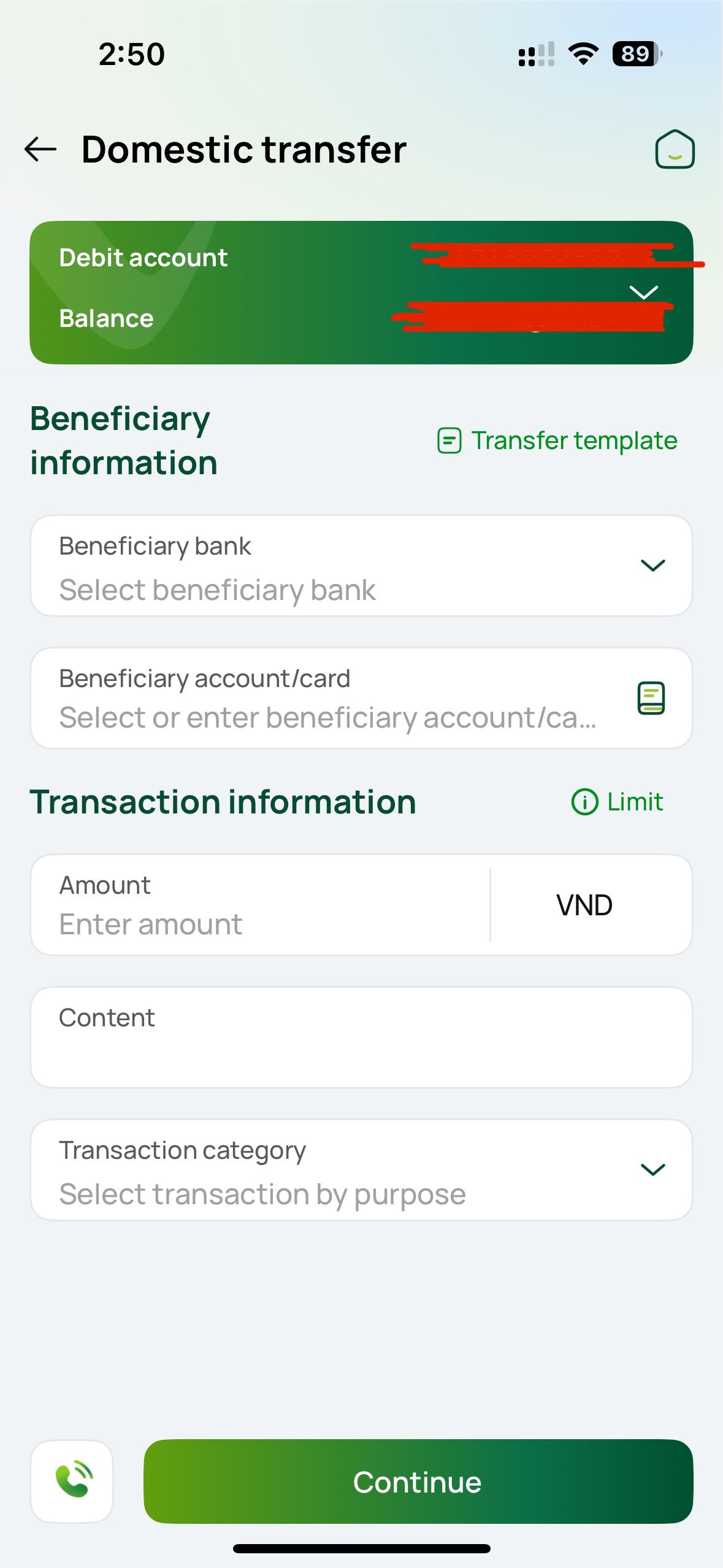
Think of Vietcombank as the JP Morgan of Vietnam. It’s state-owned, it’s massive, and it’s boring in all the right ways.
Why VCB matters:
- Repatriation. If you ever need to send a large sum OUT of Vietnam (say, $20,000+ after selling your house or cashing out investments), you’ll likely need Vietcombank. They have the cleanest SWIFT connections and the most experience handling foreign exchange documentation.
- Brokerage linkage. Most Vietnamese stock brokerage accounts (SSI, VPS, VCSC) require a bank account for deposits. Vietcombank is universally accepted. Some brokers only accept VCB.
- International credibility. When a Vietnamese landlord, employer, or business partner asks for your bank details, saying “Vietcombank” signals stability. It’s like showing up with an American Express card instead of a Discover card.
The catch: VCB’s app is… fine. It works. But it’s cluttered with features you’ll never use (insurance offers, lottery promotions, government payment portals). The UI feels like it was designed by a committee in 2016.
The branches are even worse. VCB operates like a DMV. You take a number. You wait. The teller asks you to fill out a form. Then she asks for another form. Then she photocopies your passport for the third time. Bring a book.
The real strategy: Use Vietcombank to receive your salary and for large international transfers. Then immediately transfer 80% of it to Techcombank for daily spending. Best of both worlds.
Once your Vietcombank account is set up, don’t let cash sit idle in a zero-interest checking account. You can earn up to 5.5-6% tax-free with VND term deposits — I explain the full strategy in my dedicated guide.
Category 3: The “Global Banks” (HSBC, Standard Chartered, Shinhan)
The promise: Seamless integration with your home country account. English-speaking staff. Familiar branding.
The reality: Disappointment.
Why Global Banks Usually Disappoint in Vietnam
I’m going to be blunt: Global banks in Vietnam have terrible apps.
HSBC Vietnam’s app is slower than their 2012 website. Standard Chartered’s app crashes if you try to transfer money during peak hours. Shinhan’s app looks like it was designed for a flip phone.
The fee problem:
- HSBC charges 5,500 VND per Napas transfer (roughly $0.22). That doesn’t sound like much until you’re sending money 50 times a month.
- Standard Chartered has monthly account maintenance fees if your balance drops below $500.
- Meanwhile, Techcombank and Timo charge zero for the same services.
The ATM problem: HSBC has maybe 20 ATMs in all of Ho Chi Minh City. Techcombank has 200+. Good luck finding an HSBC ATM when you need cash at 11 PM in District 2.
When Global Banks Make Sense
There are exactly three scenarios where opening an HSBC or Standard Chartered account in Vietnam is worth it:
- You already bank with them globally. If you have an HSBC Premier account in the US or UK, you can link it to your Vietnam account for easier transfers. This is genuinely useful.
- You need pristine English support. HSBC’s customer service staff in Vietnam speak native-level English. If you’re terrified of miscommunication, this matters.
- You’re only staying 3-6 months. You don’t care about optimizing fees or app quality — you just want something familiar that won’t require learning a new system.
For everyone else? Skip the global banks. Use Vietcombank for safety and Techcombank for daily life. You’ll save money and avoid frustration.
The “Pro Combo” Strategy: Why One Bank Isn’t Enough
Here’s what I wish someone told me on Day 1: Don’t put all your money in one Vietnamese bank. Not because banks here are unsafe (they’re fine), but because different banks serve different purposes.
The expats who figured this out early run a simple two-account system. Here’s how it works.
The Two-Bank Setup That Actually Makes Sense
Account #1: Vietcombank (The Vault)
Purpose: Receive salary, store emergency funds, handle international transfers.
What goes here:
- Your monthly paycheck from your Vietnamese employer
- Any large wire transfers from abroad (family support, home country savings, etc.)
- 3-6 months of emergency expenses
What you DON’T do: Don’t use this account for daily spending. The app is clunky. You don’t want to be fumbling through VCB’s cluttered interface just to pay for banh mi.
Account #2: Techcombank or Timo (The Daily Driver)
Purpose: Coffee, groceries, rent, Grab rides, gym membership, literally everything else.
The workflow: Once a month (or whenever your salary hits), transfer your spending money from Vietcombank to Techcombank via Napas. Takes 3 seconds. Costs zero dong.
Now you have your serious money sitting safely in Vietnam’s largest state-owned bank, and your spending cash in an app that doesn’t make you want to throw your phone.
The math: Let’s say you earn 50 million VND/month ($2,000). Here’s how I’d split it:
- Vietcombank: 35 million VND (savings + buffer)
- Techcombank: 15 million VND (rent, food, transportation, fun)
Adjust based on your spending habits, but you get the idea. Keep the bulk safe. Move what you need for daily life.
Moving Money INTO Vietnam: The Wise Solution
The problem: International wire transfers to Vietnamese banks are expensive and slow. Your US bank charges $40-50. The transfer takes 3-5 business days. Vietcombank might call you to verify the source of funds (anti-money laundering protocol).
The Solution: Wise (Formerly TransferWise)
Wise is a London-based fintech that specializes in international transfers. Here’s why expats use it:
- Fee: ~0.5-0.7% of the transfer amount (vs. 3-5% at traditional banks)
- Speed: Usually arrives in 1-2 business days
- Exchange rate: Mid-market rate (the “real” rate you see on Google), not the marked-up rate banks use
Real example: You want to send $1,000 from your US bank to your Vietcombank account.
- Traditional wire: You pay $45 fee + bad exchange rate. You receive ~23.2 million VND.
- Wise: You pay $7 fee + real exchange rate. You receive ~24.8 million VND.
That’s a 1.6 million VND difference (~$65). Do this monthly and you’ve saved $780/year. I cover all the transfer options — Wise, Remitly, OFX, and bank wires — in my full guide to sending money to Vietnam.
How Wise works:
- Open a Wise account (takes 10 minutes, requires ID verification)
- Add money from your home country bank (via debit card or ACH)
- Enter your Vietnamese bank details (account number + SWIFT code)
- Wise sends the money in VND directly to your account
One caveat: Wise works brilliantly for sending money to Vietnam. Getting money out of Vietnam is harder due to Vietnamese foreign exchange regulations. The short version: you’ll need documentation (tax receipts, work contract, etc.) to send large sums abroad. Vietcombank handles this process better than anyone else — hence why you need them as your “vault.”
Your Vietcombank account is also the gateway to investing. Use it to fund your stock brokerage account — I walk through the full process step by step.
The Alternatives: Remitly, Xe, or PayPal?
Remitly: Popular for smaller amounts ($100-500). Slightly higher fees than Wise, but sometimes offers promotions for first-time users.
Xe (formerly HiFX): Similar to Wise. Works fine, but slightly worse exchange rates in my experience.
PayPal: Do not use PayPal to send money to Vietnam. The fees are predatory (4-5%) and the exchange rate markup is even worse. You’ll lose 8-10% of your transfer. PayPal is designed for e-commerce payments, not international remittances.
Crypto (USDT, Bitcoin): Some expats use stablecoins to move money, especially those working remotely for overseas clients. This works but requires a Vietnamese crypto exchange account (Binance P2P, Remitano) and comes with volatility risk + regulatory gray zones. Not beginner-friendly.
Moving Money OUT of Vietnam: The Repatriation Reality
This topic deserves — and gets — its own guide. Here’s the short version:
If you’re sending less than $5,000/year abroad: Relatively easy. You can do it through Vietcombank’s online banking with minimal paperwork (usually just your passport + proof of income).
If you’re sending $10,000+: You’ll need to visit a Vietcombank branch with tax payment receipts (proving you paid Vietnamese income tax), your employment contract (proving the money was legally earned), and sometimes a letter from your employer.
This is where Vietcombank’s experience matters. Their staff know the State Bank of Vietnam’s regulations. Smaller banks might refuse the transaction just because the teller doesn’t want to deal with the paperwork.
The frustrating truth: Vietnam’s capital controls exist to prevent money laundering and maintain currency stability. As a legal expat worker, you can repatriate your earnings — but you have to prove they’re legitimate. Keep your tax receipts. Keep your employment contract. Make Vietcombank your partner in this process. For the complete walkthrough, read my sending money to (and from) Vietnam guide.
The Pro Move: Keep Your Home Country Account Open
One mistake I see new expats make: They close their US/UK/Australian bank account to “simplify.”
Don’t do this.
Keep at least one account in your home country open. Here’s why:
- Subscriptions: Netflix, Spotify, New York Times, Amazon Prime — many services don’t accept Vietnamese credit cards or flag them as fraud risks.
- Credit history: If you ever move back home, having an active credit card with a 10-year history matters for mortgages, car loans, etc.
- Emergency buffer: If something goes catastrophically wrong in Vietnam (medical emergency, political instability, natural disaster), you want money accessible outside the country.
The setup:
- Keep a US/home country checking account with $500-1,000
- Keep one credit card active (use it for 1-2 subscriptions to avoid closure)
- Set up auto-pay so you don’t miss payments while abroad
This costs you basically nothing and provides massive peace of mind.
Pick the Right Tool for the Job
Banking in Vietnam isn’t complicated once you understand the ecosystem. Stop trying to find “the perfect bank.” There isn’t one.
Instead, build a system:
- Vietcombank = Your fortress. Salary goes here. International transfers go here. This is your anchor.
- Techcombank or Timo = Your daily weapon. Fast, free, and actually pleasant to use.
- Wise = Your bridge. Moving money from home? Use Wise and save 80% on fees.
- Home country account = Your safety net. Keep it alive. You’ll thank yourself later.
The weekly routine:
- Salary hits Vietcombank (every month)
- Transfer spending money to Techcombank via Napas (takes 30 seconds)
- Pay for everything with Techcombank app or card
- Sleep well knowing your serious money is safe in VCB
This setup has worked for thousands of expats. It’ll work for you.
Frequently Asked Questions
Can foreigners open a bank account in Vietnam?
Yes, but with restrictions based on visa type. Foreigners with a Work Permit or Temporary Residence Card (TRC) can open full-service accounts — savings, checking, credit cards, and international transfers. Tourists on e-visas or 90-day visas are limited to “Non-resident Payment Accounts” with severe restrictions (no cash deposits, no savings, no debit cards). In practice, most banks refuse to open accounts for tourists due to anti-money laundering compliance concerns.
Which bank is best for expats in Vietnam?
Most experienced expats use a two-bank system: Vietcombank for salary, savings, and international transfers (it’s state-owned with the best SWIFT infrastructure), and Techcombank for daily spending (zero-fee transfers, excellent English app, instant 24/7 payments). Timo is a good alternative for newcomers who want 100% online account opening with English-speaking support. Avoid global banks like HSBC unless you already have an account with them — their apps are worse and fees are higher than local banks.
How do I send money to my Vietnam bank account from the US?
Use Wise (formerly TransferWise) instead of a traditional bank wire. Wise charges 0.5-0.7% fees with mid-market exchange rates, while US banks charge $40-50 per wire with marked-up rates. On a $1,000 transfer, Wise saves roughly $65 compared to a bank wire. The money arrives in 1-2 business days directly to your Vietnamese bank account. You’ll need your Vietnamese account number and the bank’s SWIFT code.
Can I send money out of Vietnam as a foreigner?
Yes, but you’ll need documentation proving the money was legally earned. For amounts under $5,000/year, Vietcombank’s online banking handles it with minimal paperwork. For larger amounts ($10,000+), visit a Vietcombank branch with your tax payment receipts, employment contract, and sometimes an employer letter. Vietcombank has the most experience with foreign exchange repatriation — smaller banks may refuse due to the compliance complexity.
Keep Reading
- Transfer money cheaper: The Cheapest Ways to Send Money to Vietnam (2026)
- Earn interest on your savings: Vietnam Term Deposits: Earn 5.5-6% Tax-Free
- Start investing: How to Open a Vietnam Brokerage Account (Step-by-Step)
- Budget your new life: Cost of Living in Vietnam (2026 Reality Check)