Cost of Living in Vietnam 2026: The Real Budget for Expats & Retirees.
Last updated: February 28, 2026 (Originally published: January 7, 2026)
Stop asking “How cheap is a beer?” Start asking a better question: “What does it cost to buy back my time?”
I moved to Ho Chi Minh City in 2016. I track every dollar that enters and exits my accounts. And after a decade of spreadsheets, visa runs, and watching hundreds of expats come and go, I can tell you this: Vietnam is not about cheap beer. It is about restructuring the math of your entire financial life.
This is geo-arbitrage. You earn in a strong currency — USD, EUR, GBP — and you spend in Vietnamese dong. The dong has depreciated roughly 3-4% annually against the dollar for years. Your overseas income or investment portfolio quietly grows in local purchasing power while you sleep.
But geo-arbitrage only works if you understand the real numbers. Let me give them to you.
The Southeast Asia Triangle: Vietnam vs. Thailand vs. Singapore
Singapore is the benchmark. It is safe, efficient, and brutally expensive. A one-bedroom apartment in the city center runs $2,500-3,500 per month. Add food, transport, and the general cost of existing, and you need $5,000-6,000 monthly just to feel comfortable. Singapore rewards high earners. It punishes everyone else.
Thailand was the default choice for a generation of expats. Bangkok still offers solid infrastructure and familiar Western comforts. But the math has shifted. Thai visa rules tightened. The 60-day tourist visa requires more proof of funds than before. Long-term options like the Elite Visa cost $15,000-20,000 upfront. Meanwhile, Thai housing prices in expat-friendly areas like Sukhumvit or Chiang Mai have crept up 20-30% since 2019.
Vietnam sits in a different position. A two-bedroom apartment in Thao Dien — the most popular expat district in Saigon — costs $800-1,500. The same quality in Bangkok’s Thonglor runs $1,200-2,000. The 90-day e-visa costs $25 and takes five minutes online. A full meal of pho costs $2. High-speed fiber internet costs $10-15 per month.
Run the comparison across a full year. A comfortable expat lifestyle in Singapore costs $60,000-72,000 annually. In Bangkok, roughly $30,000-40,000. In Ho Chi Minh City, you can live well on $22,000-30,000.
That $30,000-40,000 difference is not trivial. It is years shaved off your FIRE timeline. It is the gap between working until 55 and walking away at 45.
The Reality Check: Lifestyle Creep Will Find You
Here is what nobody tells you before you land at Tan Son Nhat.
You can spend $5,000 per month in Saigon. Easily. The expat bubble exists, and it has excellent air conditioning.
It starts small. You move from a $500 local apartment to an $1,100 serviced unit at Vinhomes because the gym is nicer. You stop taking Grab Bike and start taking Grab Car because it is hot and you are tired. You eat at the new Italian place in District 2 instead of the com tam spot around the corner. Your coffee migrates from 25,000 dong iced ca phe sua da to 95,000 dong flat whites at specialty roasters.
None of these choices are wrong. But they add up. The $1,500/month budget becomes $2,500. Then $3,500. Then you are spending nearly what you spent in Austin or Melbourne, except now you have to deal with visa runs and you cannot vote.
I have watched this happen to dozens of people. They arrive with spreadsheets and FIRE calculators. Eighteen months later, they are living in a $2,000 apartment, eating brunch every weekend, and wondering why their savings rate collapsed.
The geo-arbitrage advantage only works if you actually capture the savings. Vietnam gives you the opportunity. Whether you take it depends on your discipline.
What This Guide Covers
The sections that follow break down the real costs across housing, food, transport, healthcare, visas, and the hidden expenses that catch newcomers off guard. Every number comes from lived experience and current 2026 pricing.
I will also show you how Vietnam’s cost structure interacts with your investment strategy. If you can generate $2,500 per month in passive income, you can live comfortably here indefinitely. At a 4% safe withdrawal rate, that requires a $750,000 portfolio. But Vietnamese dividend stocks and bank deposits yield 5-7%. At that rate, you need only $450,000-500,000 to produce the same income.
Vietnam does not just reduce your expenses. It can reduce the size of the portfolio you need to achieve financial independence.
That is the real math. Let’s get into the details.
The Detailed Breakdown: Three Budgets, Three Lifestyles
Every expat in Vietnam falls into one of three financial profiles. The difference between them is not just money. It is a different relationship with the city, different trade-offs, and different levels of friction in daily life.
Here is what each tier actually costs in 2026:
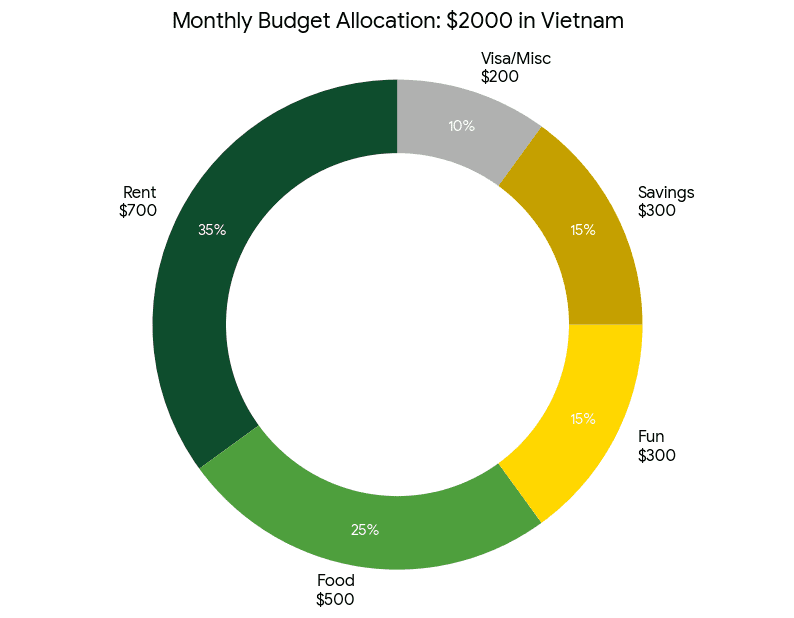
Profile 1: The Bootstrapper — $800 to $1,200/month
Who this is: English teachers, digital nomads building their first business, backpackers who decided to stay, young remote workers stretching runway.
The mindset: Optimize for savings rate. Comfort is secondary. Every dollar not spent is a dollar invested.
| Category | Monthly Cost | Notes |
|---|---|---|
| Housing | $300–500 | Studio or shared apartment in local Vietnamese neighborhood (Binh Thanh, Go Vap, Thu Duc) |
| Food | $150–250 | Street food and local com binh dan (worker’s lunch) 80% of meals |
| Transport | $50–80 | Motorbike rental ($50) + gas ($15–20) |
| Utilities | $30–50 | Electricity, water, internet |
| Phone | $7 | Unlimited 4G data (Viettel or Vinaphone) |
| Entertainment | $50–100 | Bia hoi sessions, occasional Western meal |
| Health Insurance | $15–25 | Basic local coverage or none |
| Visa Costs | $50–80 | E-visa amortized monthly |
| Total | $800–1,200 |
Housing at this tier: You are not living in Thao Dien. You are in a Vietnamese neighborhood where your landlord speaks minimal English and your neighbors are curious about you. A studio near a university or in an emerging district runs $250–400. Air conditioning exists but you use it sparingly. The trade-off: authentic immersion and maximum savings. The cost: occasional inconvenience and a longer commute to expat amenities.
Food math: A bowl of pho costs 40,000–50,000 dong ($1.60–2.00). Banh mi runs 25,000–35,000 dong ($1.00–1.40). Com binh dan — the rice-and-dishes lunch spots that feed office workers — costs 35,000–50,000 dong for a full plate. If you eat like a local, your food bill stays under $200 easily. The moment you start craving Western brunches and craft cocktails, this budget breaks.
Transport reality: At this level, you need a motorbike. Rental costs $50/month for a Honda Wave or Vision. Gas runs another $15–20. This gives you unlimited mobility across the city. Grab Bike works for occasional trips, but relying on it daily adds up fast.
Insider tip: This budget requires discipline and a tolerance for heat. The biggest variable is electricity. Keep the AC off during the day, use it only for sleeping, and your bill stays around $30–40. Leave it running 24/7 in a studio, and you are looking at $80–100 — enough to blow your entire buffer.
Profile 2: The Comfortable Professional — $1,800 to $2,500/month
Who this is: Remote workers with stable income, mid-career professionals, digital nomads earning $4,000–8,000/month, early retirees with modest portfolios.
The mindset: Balance. Save meaningfully while enjoying the city. No daily friction. Occasional indulgence without guilt.
| Category | Monthly Cost | Notes |
|---|---|---|
| Housing | $700–1,200 | 1-2BR apartment in expat-friendly area (Thao Dien, Binh Thanh, District 7) |
| Food | $350–500 | Mix of local (60%) and Western (40%) |
| Transport | $100–150 | Grab Car for most trips, occasional motorbike |
| Utilities | $70–100 | AC runs more freely |
| Phone | $7 | Unlimited 4G |
| Gym/Fitness | $40–80 | California Fitness, F45, or building gym |
| Entertainment | $150–250 | Restaurants, bars, coffee shops, weekend trips |
| Health Insurance | $80–150 | Mid-tier international outpatient coverage |
| Visa Costs | $50–80 | E-visa amortized |
| Miscellaneous | $100–150 | Haircuts, household items, services |
| Total | $1,800–2,500 |
Housing at this tier: This is where Thao Dien enters the picture. A one-bedroom at Masteri Thao Dien or The Ascent runs $700–1,000. Two bedrooms at Gateway or Estella Heights cost $900–1,300. These buildings have pools, gyms, security, and English-speaking management. You are paying for convenience and community — most of your neighbors are expats or wealthy Vietnamese.
District 7 (Phu My Hung) offers similar quality at slightly lower prices, but feels more suburban and isolated. Binh Thanh sits between local and expat worlds, with good options in the $600–900 range.
The Da Nang alternative: If you work remotely and do not need Saigon’s energy, Da Nang cuts your housing cost significantly. A luxury two-bedroom apartment near My Khe Beach runs $400–700. The same money that gets you a cramped one-bedroom in Thao Dien buys you ocean views and a rooftop pool in Da Nang. The trade-off: smaller expat community, fewer international food options, and a sleepier nightlife scene.
Food reality: At this budget, you eat well. Lunch might be bun cha at a local spot for $2.50. Dinner might be a $15 steak at a District 2 bistro. Weekend brunch with eggs benedict and a flat white runs $12–18. You stop counting every meal and start enjoying the variety.
Transport upgrade: Most professionals at this level ditch the motorbike and use Grab Car. A typical trip across District 2 costs $3–5. Airport runs cost $8–12. Monthly transport sits around $100–150 if you are not commuting to an office daily. Some people keep a motorbike for quick errands and use Grab for longer trips or rainy days.
Insider tip on electricity: This is the tier where AC bills can shock you. A two-bedroom apartment running two air conditioning units for 8–10 hours daily can generate a $100–150 electricity bill. Vietnam uses progressive pricing — the more you consume, the higher the per-unit rate. Budget $70–100 for utilities and track your first few bills carefully.
Profile 3: The Luxury Retiree — $3,500 to $5,000+/month
Who this is: Successful entrepreneurs, executives on expat packages, retirees with $1M+ portfolios, families with two incomes.
The mindset: Quality of life is the priority. Money is a tool, not a constraint. Vietnam offers luxury at a fraction of Western prices.
| Category | Monthly Cost | Notes |
|---|---|---|
| Housing | $1,500–2,500 | 2-3BR serviced apartment or high-end condo (Vinhomes, Diamond Island, District 1) |
| Food | $600–1,000 | Fine dining, premium groceries, home cooking with imported ingredients |
| Transport | $200–400 | Grab Car exclusively, occasional private driver |
| Domestic Help | $200–400 | Housekeeper 2-3x/week, laundry service |
| Utilities | $100–150 | AC runs freely |
| Phone | $7 | |
| Gym/Wellness | $150–300 | Premium gym, yoga, spa treatments, massage |
| Entertainment | $400–600 | High-end restaurants, clubs, golf, weekend resort trips |
| Health Insurance | $200–300 | Comprehensive international coverage |
| Visa Costs | $50–80 | Or invest in proper long-term visa solutions |
| Miscellaneous | $200–400 | Premium services, imported goods |
| Total | $3,500–5,500 |
Housing at this tier: You are choosing between District 1 serviced apartments with city views, Vinhomes Central Park towers overlooking the Saigon River, or villas in Thao Dien with private gardens. A three-bedroom at Vinhomes Golden River runs $1,800–2,500. Serviced apartments in District 1 with daily cleaning start around $2,000. At this level, the building staff knows your name and your packages appear at your door.
The luxury gap: Here is the arbitrage that matters most. This lifestyle — the river-view apartment, the weekly massages, the housekeeper, the fine dining — would cost $8,000–12,000 monthly in Singapore or $6,000–9,000 in a major US city. Vietnam delivers it for $4,000–5,000. You are not living cheaply. You are living well at a discount.
Domestic help: A housekeeper visiting twice weekly costs $150–200/month. Full-time help runs $300–500. A personal driver costs $600–800. These services feel like luxuries in the West. In Vietnam, they are standard for this income tier and free up significant time.
Rent is rising in major cities. Check the latest HCMC & Hanoi property prices to negotiate better. And if you’re considering buying instead of renting at this budget level, read my renting vs buying analysis first.
Hidden Costs: The Line Items That Catch You
Visas: The 90-Day Shuffle
Vietnam’s e-visa system is straightforward. Apply online, pay $25, receive approval in 3 business days, stay 90 days. No interview. No proof of funds. No return ticket required.
The catch: after 90 days, you must leave. Most expats fly to Bangkok, Singapore, or Kuala Lumpur, spend a night or two, and return on a fresh e-visa.
The real cost of visa runs:
| Expense | Cost |
|---|---|
| Round-trip flight to Bangkok | $80–150 |
| One night hotel | $30–60 |
| New e-visa | $25 |
| Airport transport and meals | $30–50 |
| Total per run | $165–285 |
You need four visa runs per year. Budget $800–1,200 annually, or roughly $70–100/month amortized.
The long-term solution: If you work for a Vietnamese company or establish a business, you can obtain a work permit and Temporary Residence Card (TRC). This eliminates visa runs entirely. Some retirees obtain investor visas through property purchases or business registration, though these require significant capital and paperwork. For the complete retirement planning picture, see my guide to retiring in Vietnam.
Insider tip: Time your visa runs strategically. Fly to Bangkok or KL when you actually want a weekend trip. The visa run becomes a mini-vacation rather than pure friction.
Health Insurance: Do Not Gamble Here
This is where bootstrappers make dangerous mistakes.
Local Vietnamese insurance costs $150–250/year. It covers basic outpatient visits and some hospital stays at local facilities. It does not cover international hospitals like FV Hospital or Vinmec, where you actually want to go if something serious happens.
The three tiers of coverage:
| Tier | Annual Cost | What You Get |
|---|---|---|
| Local basic | $150–250 | Vietnamese hospitals, limited coverage, lots of exclusions |
| Mid-tier international | $800–1,500 | Outpatient + inpatient at international hospitals, reasonable deductibles |
| Comprehensive international | $2,000–4,000 | Full coverage, evacuation, home country treatment, global portability |
The recommendation: At minimum, carry mid-tier international coverage. A serious accident or illness at a local hospital with language barriers and different care standards is not worth the $50/month you saved.
FV Hospital in District 7 and Vinmec in Binh Thanh offer Western-standard care with English-speaking staff. A single night in these facilities costs $300–500 without insurance. Surgery or extended stays can run $10,000–30,000.
Budget $1,000–1,500/year for proper coverage. This is $80–125/month. It is non-negotiable.
The Family Warning: International Schools
If you have children, ignore everything above. Your budget math changes completely.
International school fees in Ho Chi Minh City:
| School Tier | Annual Tuition | Examples |
|---|---|---|
| Mid-tier international | $8,000–15,000 | Australian International School, Renaissance |
| Premium international | $18,000–25,000 | British International School, European International School |
| Elite tier | $25,000–35,000 | Saigon South International School (SSIS), UNIS Hanoi |
These figures are per child, per year. A family with two children at a premium school faces $36,000–50,000 in tuition alone — before housing, food, or any other expense.
Add family-sized housing ($1,500–2,500/month), a car with driver for school runs, activities and supplies, and a family of four needs $6,000–10,000/month to maintain a comfortable expatriate lifestyle.
The calculation shifts: For families, Vietnam is no longer dramatically cheaper than other options. Bangkok’s international schools cost slightly less. Malaysia offers strong value. Singapore schools, while expensive, come with a more established system.
Vietnam still works for families — especially those with remote income who value the culture and lifestyle. But the FIRE math that makes Vietnam attractive for singles and couples does not translate directly to families with school-age children.
The Bottom Line: Know Your Number
| Profile | Monthly Budget | Annual Cost | Portfolio (4% SWR) | Portfolio (6% VN Yield) |
|---|---|---|---|---|
| Bootstrapper | $1,000 | $12,000 | $300,000 | $200,000 |
| Comfortable Pro | $2,200 | $26,400 | $660,000 | $440,000 |
| Luxury Retiree | $4,500 | $54,000 | $1,350,000 | $900,000 |
The numbers clarify decisions. A $500,000 portfolio generating 6% in Vietnamese dividend stocks produces $30,000/year — enough for a comfortable professional lifestyle with buffer. The same portfolio at 4% withdrawal from US index funds produces only $20,000, forcing you into bootstrapper territory.
This is why Vietnam is not just about cheap beer. It is about restructuring what financial independence requires.
The Financial Freedom Calculation: Why Vietnam Changes the Math
This is where the conversation shifts from lifestyle to strategy.
Travel blogs will tell you Vietnam is cheap. They will show you photos of $1 banh mi and $3 massages. What they will not do is run the numbers that actually matter: how much capital do you need to never work again?
Let me show you the math that changed my life.
The Core Equation: What Does Freedom Cost?
The “Comfortable Professional” lifestyle in Vietnam costs $2,500 per month. This includes a quality apartment in Thao Dien, a mix of local and Western food, Grab transport, proper health insurance, and enough buffer for entertainment and quarterly visa runs.
Annual cost: $30,000.
Now compare this to what the same lifestyle costs in major US cities:
| City | Monthly Cost | Annual Cost |
|---|---|---|
| Ho Chi Minh City | $2,500 | $30,000 |
| Austin, TX | $4,500 | $54,000 |
| Denver, CO | $5,000 | $60,000 |
| San Diego, CA | $5,500 | $66,000 |
| New York, NY | $7,000 | $84,000 |
The gap is not marginal. Vietnam costs 45–65% less than comparable US cities for the same quality of life. In some cases, Vietnam offers a better lifestyle — domestic help, premium gym access, frequent restaurant meals — at half the price.
This cost difference compounds dramatically when you calculate the portfolio required to sustain it.
The Capital Requirement: US Retirement vs. Vietnam Retirement
The standard FIRE calculation uses the 4% safe withdrawal rate. This rule, derived from the Trinity Study, suggests you can withdraw 4% of your portfolio annually with low risk of running out of money over 30 years. It assumes a US-based portfolio of stocks and bonds.
| Location | Annual Expenses | Portfolio Required (4% SWR) |
|---|---|---|
| Ho Chi Minh City | $30,000 | $750,000 |
| Austin | $54,000 | $1,350,000 |
| Denver | $60,000 | $1,500,000 |
| San Diego | $66,000 | $1,650,000 |
| New York | $84,000 | $2,100,000 |
To retire comfortably in Austin, you need $1.35 million. To retire with the same lifestyle in Saigon, you need $750,000.
That is a $600,000 difference. At a $50,000 annual savings rate, that gap represents twelve years of work.
Read that again. Moving to Vietnam can subtract a decade from your working life.
To save on transaction fees while living here, make sure you use the best local banks for expats — the right setup saves you $780+/year on transfers alone.
The Yield Advantage: Making Your Capital Work Harder
Here is where Vietnam offers a second edge that most expats overlook entirely.
The 4% rule assumes you are invested in US markets yielding modest dividends (S&P 500 dividend yield hovers around 1.3–1.5%) supplemented by capital appreciation and bond income. It is a conservative framework designed for longevity.
Vietnam’s market offers a different structure. Blue-chip Vietnamese stocks pay substantially higher dividends. Bank term deposits offer rates that disappeared from the West fifteen years ago.
| Investment | Current Yield (2026) | Notes |
|---|---|---|
| Vinamilk (VNM) | 4.5–5.5% | Monopoly in dairy, consistent payer, defensive stock |
| PetroVietnam Gas (GAS) | 6–8% | State monopoly, massive cash reserves, critical infrastructure |
| Vietcombank (VCB) | 1.5–2% | Lower yield but highest quality bank |
| High-dividend bank stocks | 3–5% | TCB, MBB, ACB offer moderate yields with growth |
| VND Term Deposits (12-month) | 5–6% | Principal guaranteed, no market risk |
| Corporate Bonds (via funds) | 7–9% | Higher risk, requires due diligence |
A portfolio tilted toward Vietnamese dividend stocks and term deposits can realistically generate 5–7% annual income without touching principal.
| Withdrawal Strategy | Annual Income Needed | Portfolio Required |
|---|---|---|
| 4% SWR (US Standard) | $30,000 | $750,000 |
| 5% Vietnam Yield | $30,000 | $600,000 |
| 6% Vietnam Yield | $30,000 | $500,000 |
| 7% Vietnam Yield | $30,000 | $428,000 |
At a 6% yield from Vietnamese investments, you need $500,000 to generate $30,000 annually. That is $250,000 less than the US-based 4% calculation.
Combined with lower living costs, the total advantage is staggering:
| Scenario | Portfolio Required |
|---|---|
| Retire in Austin on US investments (4% SWR) | $1,350,000 |
| Retire in Vietnam on US investments (4% SWR) | $750,000 |
| Retire in Vietnam on VN investments (6% yield) | $500,000 |
The difference between retiring in Austin on a US portfolio and retiring in Vietnam on a Vietnam portfolio is $850,000.
At a $40,000 annual savings rate, that is over twenty years of work. At $60,000, it is fourteen years.
This is not a rounding error. This is a different life.
Building the Income Stream: A Practical Approach
I am not suggesting you liquidate your US brokerage account and wire everything to Vietnam tomorrow. Currency risk is real. The dong depreciates. Emerging market volatility is higher. Regulatory changes happen.
A balanced approach looks like this:
| Allocation | Purpose | Yield Contribution |
|---|---|---|
| 50% US/Global Equities | Growth, diversification, USD hedge | ~2% dividends + appreciation |
| 25% Vietnam Blue Chips | Income, local currency matching | ~5–6% dividends |
| 15% Vietnam Term Deposits | Stability, guaranteed income | ~5–6% interest |
| 10% Cash Buffer | Emergency fund, opportunity capital | Minimal |
This structure keeps half your wealth in stable global markets while generating meaningful local income to cover Vietnamese expenses. Your dong-denominated costs are partially matched by dong-denominated income, reducing currency conversion drag.
Example: $600,000 Portfolio
| Allocation | Amount | Annual Income |
|---|---|---|
| US/Global Equities (50%) | $300,000 | $6,000 (2% yield) |
| Vietnam Stocks (25%) | $150,000 | $8,250 (5.5% yield) |
| Vietnam Term Deposits (15%) | $90,000 | $5,040 (5.6% yield) |
| Cash Buffer (10%) | $60,000 | — |
| Total | $600,000 | $19,290 |
This portfolio generates roughly $19,000 in passive income annually before any capital appreciation. Add modest growth from the equity portion, and you approach the $25,000–30,000 needed for comfortable living.
The $600,000 portfolio does the work that would require $1.35 million in a traditional US retirement scenario.
The Risks You Must Understand
I am not selling you a dream. I am showing you math. But math requires assumptions, and assumptions can break.
Currency Risk: The Vietnamese dong has depreciated 3–4% annually against the USD over the past decade. If this continues, your dollar-denominated wealth grows in local purchasing power. If it reverses — unlikely but possible — your costs rise relative to your portfolio. Holding some USD assets hedges this risk.
Market Risk: Vietnamese stocks are volatile. The VN-Index can swing 20–30% in a year. If you need to sell during a downturn, you lock in losses. The income approach — living off dividends rather than selling shares — mitigates this, but does not eliminate it.
Regulatory Risk: Foreign ownership limits exist on many Vietnamese stocks. Rules change. The tax treatment of dividends (currently 5% withholding for foreigners) could shift. Political and economic stability, while strong historically, is not guaranteed.
Inflation Risk: Vietnam targets 4–4.5% inflation. If costs rise faster than your income, your purchasing power erodes. The 6% yield provides a buffer, but not an unlimited one.
Concentration Risk: Putting too much into any single Vietnamese stock — even blue chips like GAS or VNM — exposes you to company-specific disasters. Diversify across sectors.
These risks are real. They are also manageable. The question is not whether Vietnam is risk-free. It is whether the risk-adjusted returns justify the dramatically lower capital requirement.
For most people running the numbers honestly, they do.
The Decision Framework
Ask yourself three questions:
1. How much do you have now? If you have $300,000, the US retirement path requires another $450,000–1,000,000 depending on your target city. At $50,000 annual savings, that is 9–20 more years of work. The Vietnam path requires another $200,000. That is four years.
2. What is your risk tolerance? If emerging market exposure keeps you awake at night, Vietnam is not for you. Stick with the traditional path and accept the longer timeline. If you can stomach volatility in exchange for freedom sooner, Vietnam offers a legitimate acceleration.
3. What do you actually want? Some people want to retire in the US near family and friends. No spreadsheet changes that. Vietnam is not better — it is different. It trades familiarity for freedom, comfort zones for adventure, and predictability for possibility.
The math only matters if the life appeals to you.
Your Next Step
If the numbers resonate, you need to understand what you are buying.
Vietnamese blue chips are not US stocks. The market operates differently. Information is harder to find. Corporate governance standards vary. Foreign ownership limits block access to some of the best companies.
I have spent a decade learning this market. I have made expensive mistakes so you do not have to.
Want to build that income stream? Start with my Top 10 Vietnam Blue Chips for 2026 — it covers which stocks pay the highest sustainable dividends, which banks offer the best risk-reward, how to navigate foreign ownership limits, and the ETF workaround that gives you access to “full” stocks like FPT.
The cost of living analysis gets you to the “why.” The blue chips guide gets you to the “how.”
Frequently Asked Questions
How much does it cost to live in Vietnam as an expat?
In 2026, a single expat can live comfortably in Ho Chi Minh City on $1,800-2,500/month, covering a one-bedroom apartment in an expat area like Thao Dien ($700-1,200), a mix of local and Western food ($350-500), Grab transport ($100-150), and mid-tier health insurance ($80-150). Budget-focused expats can manage on $800-1,200/month in local neighborhoods. Luxury living with domestic help and fine dining runs $3,500-5,500/month.
Is Vietnam cheaper than Thailand for expats?
Yes, Vietnam is generally 20-30% cheaper than Thailand for a comparable expat lifestyle. A comfortable two-bedroom apartment in HCMC’s Thao Dien costs $800-1,500/month versus $1,200-2,000 for Bangkok’s Thonglor. Food is cheaper at the local level (pho for $2 vs. pad thai for $3), and Vietnam’s 90-day e-visa costs $25 versus Thailand’s increasingly complex visa requirements. Annual comfortable expat costs run $22,000-30,000 in Vietnam versus $30,000-40,000 in Bangkok.
How much money do I need to retire in Vietnam?
Using the standard 4% safe withdrawal rate from a US-based portfolio, you need approximately $750,000 to retire comfortably in Vietnam ($30,000/year expenses). However, by investing partially in Vietnamese dividend stocks (5-6% yield) and VND term deposits (5-6% yield), a $500,000-600,000 portfolio can generate the same income. This compares to $1.35 million needed for the same lifestyle in a mid-tier US city like Austin.
What are the hidden costs of living in Vietnam?
The biggest hidden costs are visa runs ($800-1,200/year for four quarterly trips to Bangkok or KL), proper health insurance ($800-1,500/year for mid-tier international coverage), electricity bills (progressive pricing means AC-heavy apartments can hit $100-150/month), and international school fees if you have children ($8,000-35,000 per child per year). Lifestyle creep is also a major factor — many expats who arrive budgeting $1,500/month are spending $3,500 within 18 months.
Keep Reading
- Build your income stream: Top 10 Vietnam Blue Chips for 2026
- Earn 6% on savings: Vietnam Term Deposits: Tax-Free Interest Guide
- Set up your banking: Best Banks in Vietnam for Expats (2026)
- Plan your retirement: How to Retire in Vietnam (Complete Guide)
- Start investing: The Ultimate Guide to Vietnam Stock Market