How to Open a Vietnam Brokerage Account: The 2026 Step-by-Step Guide for Foreigners
Last updated: February 28, 2026 (Originally published: January 7, 2026)
Let’s address the elephant in the room. Vietnam’s bureaucracy has a reputation. Forms in triplicate. Notarized stamps on notarized stamps. The mental image of spending three days in a government office while someone goes on lunch break.
Here’s the truth: thousands of foreign investors open Vietnamese brokerage accounts every year. Australians, Americans, Germans, Singaporeans. Retirees in Da Nang. Expats in District 2. Remote workers bouncing between Hoi An and Bali. They all figured it out. You can too.
The process has improved dramatically since 2020. Online applications exist. English-speaking support desks answer emails. The largest brokers have dealt with enough foreigners that they have the playbook down cold.
Is it as easy as opening a Schwab account? No. Will it take more than fifteen minutes? Yes. But the reward is direct access to one of Asia’s fastest-growing stock markets at valuations roughly half of what you’d pay for the S&P 500. A market trading at 13-14x earnings versus 23-25x in the US. Dividend yields of 3-4% on average, with some stocks pushing 8-10% cash payouts. For the full investment case, start with my Ultimate Guide to Vietnam Stock Market.
Worth a few forms? I think so. Here’s the complete roadmap.
Path A: The ETF Shortcut (Exposure Without Paperwork)
Before diving into the full process, let’s be honest. Not everyone needs a direct brokerage account in Vietnam.
If you just want broad exposure to the Vietnam growth story — a simple allocation in your IRA or taxable account — there’s an easier path. Buy the VanEck Vietnam ETF (Ticker: VNM) on the NYSE. I’ve written a detailed VNM ETF review covering its holdings, fees, and limitations.
It trades in US dollars. It settles in two days like any American stock. Your existing Fidelity, Schwab, or Interactive Brokers account works fine. No passport notarization. No Vietnamese bank account. No learning what “T+2.5 settlement” means.
The VNM ETF holds a basket of the largest Vietnamese companies. You get Vinamilk, Hoa Phat, Vinhomes, and others in a single click. For casual investors who want 5-10% of their portfolio in Vietnam without the operational overhead, this is the logical choice.
The trade-off? You’re buying a basket, not picking your spots. The ETF includes companies you might not want. It excludes others you might love. And critically, you’re paying a management fee (currently around 0.6% annually) for the convenience. For a comparison of all available options, see my Vietnam ETF comparison guide.
For the “set it and forget it” investor, Path A works. Stop here if that’s you.
The Pivot: Why Direct Access Matters
But here’s why you’re probably still reading.
Remember the ten blue chips I profiled? FPT Corp, Techcombank, Mobile World, SSI Securities? The national champions positioned to ride Vietnam’s next decade of growth?
Several of them have a problem. Foreign ownership limits. I explain the full mechanics in my FOL guide, but here’s the summary.
FPT, the tech giant growing 20% annually? Foreign room is 100% full. Foreigners cannot buy a single share on the open market. Mobile World, the retail king staging a turnaround? Often at or near its foreign cap.
The VanEck ETF can hold these stocks because it bought in years ago. But if you want to buy them today — or if you want to own the specific companies you’ve researched rather than a pre-packaged basket — you need a direct Vietnamese brokerage account.
A direct account also lets you:
- Buy when foreign room opens. Institutions occasionally sell. Room opens. Those with accounts ready can act in minutes. Those without miss the window.
- Access the VNDIAMOND ETF (Ticker: FUEVFVND). This locally-listed ETF specifically holds the “full foreign room” stocks like FPT and MWG. You cannot buy it from New York. You need a Vietnamese account.
- Trade the full market. Small caps. Mid caps. The HNX exchange. The UPCoM market. Stocks the international ETFs don’t touch. For how the exchanges work, see my VN-Index explainer.
- Control your timing. Buy the dip during a panic. Sell into strength. You’re not waiting for an ETF manager to rebalance quarterly.
If you’re serious about Vietnam as a long-term allocation — not just a tourism-themed ticker in your portfolio — direct access is the path.
Here is exactly how to get it.
Path B: The Direct Route — A 3-Step Guide
Opening a Vietnamese brokerage account involves three distinct steps. None of them are difficult. But they must happen in sequence, and the timeline depends entirely on whether you’re physically in Vietnam or applying from abroad.
Let’s walk through each one.
Step 1: Choose Your Broker
Vietnam has dozens of securities companies. You don’t need to evaluate all of them. For foreign investors, three names consistently rise to the top. I compare all the options in detail in my best Vietnam brokers for foreigners guide, but here’s the summary.
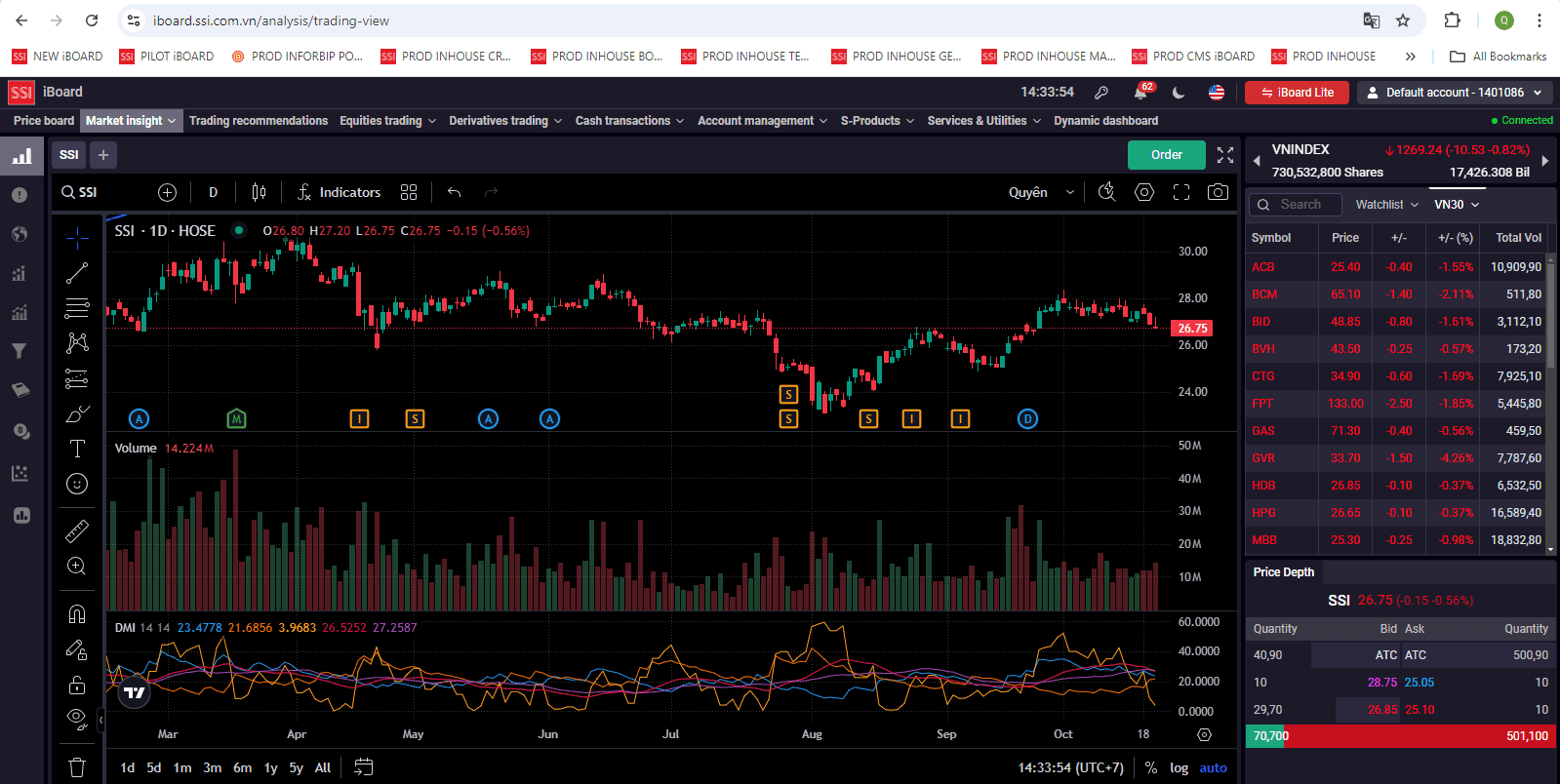
SSI Securities (Ticker: SSI) — The largest brokerage by market capitalization. SSI has handled more foreign accounts than anyone else in the market. Their English-language support is responsive. Their mobile app works. They offer an eKYC option that lets you start the process online, though full activation still requires physical documents. If you want the broker with the most experience onboarding international clients, SSI is the default choice.
VPS Securities — Strong technology platform. Competitive trading fees. VPS has invested heavily in their digital infrastructure and attracts a younger, tech-savvy client base. Good option if you prioritize a modern trading interface.
HSC (Ho Chi Minh City Securities Corporation) — The institutional favorite. HSC is known for quality research and serves many foreign funds operating in Vietnam. If you want detailed analyst reports in English and a more “wealth management” feel, HSC fits the profile.
How to decide? For most retail investors, SSI is the practical choice. They’ve processed the most foreign applications and have the operational muscle to handle questions in English. Visit their website, find the foreign investor section, and you’ll see they’ve built a process specifically for you.
One note: you can open accounts at multiple brokers. Some experienced investors maintain two — one for long-term holdings, one for active trading. But start with one. Get comfortable. Expand later if needed.
Step 2: The Paperwork (Remote vs. In-Person)
Here’s where the path splits dramatically based on your location.
If You’re in Vietnam: The One-Hour Account
This is the easy version. If you’re in Ho Chi Minh City or Hanoi — even just passing through on a trip — walk into the broker’s headquarters with your passport.
That’s it. Passport. Maybe a printed photo (though most offices can take one). Some brokers ask for proof of address, but a hotel booking confirmation often suffices for tourists.
Sit down with a representative. Fill out forms. Sign where they point. They’ll photocopy your passport, enter your details into their system, and hand you a receipt. The entire process takes 30-60 minutes depending on how busy the office is.
You’ll walk out with your account created. The trading code (more on that below) arrives within a few business days. You’re operational within a week.
If you’re planning a trip to Vietnam anyway, schedule one morning to visit a broker’s office. It’s the fastest path by far.
If You’re Abroad: The Mail-In Marathon
Now for the honest truth. Opening an account remotely from the US, Europe, or elsewhere is possible. People do it. But it requires patience and paperwork.
Here’s what you’ll need:
1. Notarized Passport Copy — Not just a photocopy. You need your passport notarized at a Vietnamese Embassy or Consulate in your country. This proves you are who you claim to be. The embassy staff will stamp and certify the copy. If there’s no Vietnamese Embassy nearby, some brokers accept notarization from your country’s notary public, then authenticated by the Vietnamese Embassy by mail. Ask your chosen broker for their specific requirements — this varies.
2. Account Opening Forms — Download these from your broker’s website. Fill them out completely. Sign with a wet signature (physical pen on paper). Digital signatures typically don’t work for the initial application.
3. Proof of Address — A utility bill or bank statement showing your overseas address. Some brokers require this notarized as well.
4. Passport-Sized Photos — Two or three physical photos. Yes, physical. Staple them to the forms as instructed.
5. Courier Everything — Compile the package. Send it via DHL, FedEx, or another tracked international courier to the broker’s head office in Vietnam. Budget $50-80 for shipping if you want reliable tracking and speed.
The Timeline: Be realistic. From the day you mail your documents to the day you can place your first trade, expect 2-4 weeks minimum:
- Courier transit: 3-5 business days
- Broker processing and verification: 3-5 business days
- Trading code issuance from VSD: 3-5 business days
- Back-and-forth if anything is incorrect: add another week
Some brokers offer partial eKYC — you upload documents online, they review, then you only mail the items requiring wet signatures. This can shave a few days off. SSI has moved furthest in this direction. But even with eKYC, the physical signature requirement remains for most account types.
Don’t sugarcoat it to yourself. If you need to trade Vietnam next week, remote account opening won’t get you there. Plan this a month before you want to be active.
Step 3: The Golden Ticket — Your Trading Code (MSGD)
Every foreign investor in Vietnam receives a unique identifier called a Trading Code, known locally as Mã số giao dịch (MSGD). Think of it as your investor ID number, issued by the Vietnam Securities Depository (VSD).
You don’t apply for this yourself. Your broker handles the application on your behalf once they’ve verified your documents. They submit your information to the VSD, and the VSD issues your code.
Why does this matter? Your trading code is linked to you permanently. It tracks your holdings across all brokers. It ensures you’re counted correctly against foreign ownership limits. It’s how the system knows “this American owns 500 shares of Vinamilk.”
The issuance process typically takes 3-5 business days after your broker submits the application. During this window, your account exists but isn’t fully active. You’re in a holding pattern.
Once the code arrives, your broker notifies you. Now you’re in the system. Now you can fund your account and trade.
One important note: the trading code is yours for life, or at least for as long as you invest in Vietnam. If you switch brokers later, your code transfers with you. You don’t reapply. This is a one-time bureaucratic hurdle, not a recurring one.
Quick Reference: Timeline Summary
| Scenario | Total Time to First Trade |
|---|---|
| In-person (Vietnam) | 5-7 business days |
| Remote (Abroad, smooth process) | 2-3 weeks |
| Remote (Abroad, document issues) | 4-6 weeks |
The fastest path is obvious. If you can combine account opening with a Vietnam trip, do it. If you can’t, start the remote process now so you’re ready when opportunity strikes.
Money & Mechanics: How Cash Actually Flows
You have a broker. Your trading code is on the way. Now comes the question that makes most foreign investors nervous: how do I get money into Vietnam, and more importantly, how do I get it back out?
The short answer: Vietnam has a clear, legal system for foreign investment capital. Thousands of investors move money in and out every year without incident. But the system has specific requirements you need to understand.
The IICA Account: Your Money’s Passport
When you open your brokerage account, you’ll also open something called an IICA — an Indirect Investment Capital Account.
Think of it as a dedicated bank account with a specific job: tracking every dollar you bring into Vietnam for investment purposes. Vietnam’s central bank (the State Bank of Vietnam) wants to know how much foreign capital enters the country, where it goes, and when it leaves. The IICA creates a clean paper trail.
How it works in practice:
- You wire US dollars (or euros, or your home currency) from your overseas bank to your IICA at a Vietnamese bank.
- The Vietnamese bank converts your foreign currency into Vietnamese dong (VND) at the prevailing exchange rate.
- The VND sits in your IICA, ready to fund trades.
- When you sell stocks, the proceeds return to your IICA in VND.
- When you want to take money home, the bank converts VND back to your foreign currency and wires it out.
Your broker will guide you through opening the IICA — it’s typically bundled with the brokerage account process. The major banks that handle foreign investor accounts (Vietcombank, BIDV, and others) have dedicated departments for this.
The key point: the IICA isn’t a restriction. It’s a tracking mechanism. Your money remains yours. The account simply documents its journey.
You will need a local bank account to fund your trades. I’ve reviewed the best banks in Vietnam for expats to help you choose. And for the cheapest ways to wire money from overseas, see my guide on sending money to Vietnam.
Repatriation: Yes, You Can Take Your Money Home
This is the fear that stops many investors cold. “What if Vietnam traps my capital? What if I can’t get my profits out?”
Let’s put this to rest.
Repatriation of capital and profits is legal, standard, and happens every day. Vietnam wants foreign investment. Trapping capital would destroy that goal overnight. The system is designed to let money flow both directions.
Here’s what you need to repatriate funds:
- Proof of tax payment. Vietnam charges a 0.1% tax on the selling price of stocks (not on your profit — on the total sale value). This is withheld automatically by your broker when you sell. You don’t file a return. You don’t calculate anything. The broker handles it and provides documentation.
- Dividend withholding. If you receive cash dividends, Vietnam withholds 5% at the source. Again, automatic. The net dividend hits your account. Documentation exists.
- A repatriation request. Tell your bank you want to convert VND to USD and wire it to your overseas account. They process it.
That’s it. No special approvals. No multi-month waiting periods. No government official deciding whether you deserve your own money.
Timeline: Most repatriation requests process within 2-5 business days, depending on the amount and your bank’s internal procedures. Large sums (millions of dollars) may require additional documentation, but for typical retail investors moving five or six figures, it’s straightforward.
One practical note: keep your records. Save your trade confirmations, dividend statements, and any tax documentation your broker provides. You probably won’t need them, but if questions ever arise — from Vietnamese authorities or your home country’s tax agency — clean records solve problems before they start.
Trading 101: The Rules That Trip Up Newcomers
Vietnamese stock trading works slightly differently than what you’re used to in New York or London. None of these differences are deal-breakers, but ignoring them will cost you money or create confusion. For a complete breakdown, read my guide to Vietnam stock market hours and trading rules.
Lot Size: Buy in Hundreds
You cannot buy a single share of Vinamilk. You cannot buy 50 shares of Techcombank. You cannot buy 137 shares of anything.
Vietnam requires trades in round lots of 100 shares. Think of it like buying eggs. You can’t ask for 7 eggs at the supermarket. You buy a dozen or you buy nothing.
Your order must be 100 shares, 200 shares, 500 shares, 1,000 shares — any multiple of 100. Enter an order for 150 shares and the system rejects it.
Why this matters for portfolio sizing: If FPT trades at 130,000 VND per share (roughly $5.20 USD), your minimum purchase is 100 shares, or about $520. Want to invest $1,000? You can buy 200 shares but not 192. For expensive stocks, the minimum investment adds up. For cheaper stocks, it’s trivial. Just remember: think in hundreds.
T+2.5 Settlement: The Waiting Game
When you buy a stock in the US, settlement happens in one business day (T+1). You buy Monday, shares are yours Tuesday.
Vietnam uses T+2.5 settlement, and that extra time matters.
Here’s the practical reality:
- Monday morning: You buy 500 shares of Hoa Phat.
- Monday to Wednesday morning: You wait. The shares are being settled.
- Wednesday afternoon: Shares land in your account.
- Thursday: You can sell.
If you buy Monday and try to sell Wednesday morning, the system blocks you. The shares haven’t arrived yet.
The mental adjustment: Don’t think of Vietnamese stocks as instantly liquid. There’s a buffer. If you’re day-trading or need to exit fast, this lag matters. If you’re investing for months or years, it’s irrelevant after your first purchase.
Trading Hours: Mind the Lunch Break
The Vietnamese stock market operates on a schedule that reflects local culture. And local culture includes a proper midday rest.
| Time | Session |
|---|---|
| 9:00 – 9:15 | ATO (Opening auction) |
| 9:15 – 11:30 | Continuous trading |
| 11:30 – 13:00 | Lunch break — Market closed |
| 13:00 – 14:30 | Continuous trading |
| 14:30 – 14:45 | ATC (Closing auction) |
Yes, the market shuts down for ninety minutes in the middle of the day. Traders eat pho. Office workers take naps. The Ho Chi Minh City trading floor goes quiet.
If you’re watching from New York (12 hours behind Vietnam), this means the market opens at 9 PM Eastern, closes for lunch at 11:30 PM, reopens at 1 AM, and closes for the day at 2:45 AM. Night owls only.
Practical tip: If you’re placing orders from abroad, use limit orders and place them before the session. You don’t need to watch the screen live. Set your price, submit the order, check results the next morning.
Daily Price Limits: The Circuit Breakers
Unlike US markets, Vietnamese stocks have daily trading bands that cap how much a price can move in a single session.
- HOSE (Ho Chi Minh Exchange): ±7% from previous close
- HNX (Hanoi Exchange): ±10% from previous close
- UPCoM (Unlisted market): ±15% from previous close
If Vinamilk closed at 100,000 VND yesterday, today it can trade between 93,000 and 107,000 VND. No higher, no lower. If buying demand pushes the price to the ceiling, it sits there. Orders queue. The stock is “limit up.”
Why this matters: In a panic or euphoria, you might not be able to exit (or enter) at the price you want. The stock hits its daily limit and freezes. You wait until tomorrow. For long-term investors, this is noise. For active traders, it’s a structural feature to respect.
Quick Reference: The Numbers That Matter
| Rule | Detail |
|---|---|
| Lot size | 100 shares minimum |
| Settlement | T+2.5 (buy Mon, sell Thu) |
| Selling tax | 0.1% of sale value |
| Dividend tax | 5% withheld at source |
| HOSE daily limit | ±7% |
| Lunch break | 11:30 – 13:00 Vietnam time |
Your First Trade Checklist
You’ve read the rules. You understand the T+2.5 delay. You know about the lunch break. Now, let’s boil this entire process down to a single cheat sheet.
Phase 1: The Setup (Weeks 1-3)
- Pick your broker: Choose SSI (safest bet) or VPS (modern app).
- Notarize your passport: Go to the Vietnamese Embassy or a notary public (depending on broker requirements).
- Mail the package: Send physical forms + photos + notarized passport to the broker’s HQ in Vietnam.
- Wait: Use this time to research your stock watchlist (read the Top 10 Blue Chips).
Phase 2: The Activation (Week 4)
- Receive Trading Code: Your broker will email you when the VSD issues your unique ID.
- Open IICA: Follow your broker’s instructions to activate your Indirect Investment Capital Account.
- Send a test transfer: Wire a small amount ($100-$500) via Wise or your bank to ensure the connection works.
Phase 3: The Execution
- Log in: Download the broker’s mobile app. Change the language to English.
- Place a Limit Order: Remember, buy in multiples of 100 shares.
- Check the status: If the market is closed (lunch or night), the order will stay “Pending” until the next session.
- Celebrate: You now own a piece of the fastest-growing economy in Southeast Asia.
The Barrier Is the Opportunity
If you’re feeling exhausted just reading about the paperwork, the couriers, and the notarizations — good.
That exhaustion is exactly why the opportunity exists.
If opening a Vietnamese brokerage account were as easy as downloading Robinhood, global capital would have already flooded in. The P/E ratio wouldn’t be 13x; it would be 20x. The dividend yields wouldn’t be 5%; they’d be 2%. The bureaucratic friction is the “moat” that protects these valuations. It keeps the tourists out and leaves the alpha for those willing to do the work.
You now have the roadmap. The forms are annoying, but they are finite. You do them once, and you have access for a lifetime. And with the FTSE upgrade expected in September 2026, getting positioned before billions in passive fund flows arrive is the smart play.
Don’t let a trip to the post office stand between you and the next decade of Vietnam’s growth.
Frequently Asked Questions
Can Americans open a brokerage account in Vietnam?
Yes, Americans can open brokerage accounts in Vietnam. The process requires a notarized passport copy, account opening forms, and physical documents sent to the broker’s office. If you’re in Vietnam, you can walk into a broker like SSI Securities and complete the process in about an hour. From the US, expect 2-4 weeks via mail. Once approved, the Vietnam Securities Depository (VSD) issues a permanent trading code that lets you buy and sell stocks on all Vietnamese exchanges.
How do I fund a Vietnamese brokerage account from abroad?
You fund your account through an IICA (Indirect Investment Capital Account) — a special bank account that tracks foreign investment capital. Wire USD or your home currency from your overseas bank to your IICA at a Vietnamese bank (typically Vietcombank or BIDV). The bank converts it to VND at market rates, and the funds become available for trading. Services like Wise can reduce transfer fees compared to traditional bank wires.
Can I get my money out of Vietnam after investing?
Yes, capital repatriation is legal, standard, and happens daily. When you want to withdraw, your bank converts VND back to your foreign currency and wires it to your overseas account. The process typically takes 2-5 business days. Vietnam automatically withholds 0.1% selling tax on stock sales and 5% on dividends — both handled by your broker, so there’s no separate filing required before repatriation.
Which is the best broker in Vietnam for foreigners?
SSI Securities is the most popular choice for foreign investors — they’ve processed the most international accounts and offer English-language support, a functional mobile app, and partial eKYC (online onboarding). VPS Securities is strong on technology and fees, while HSC appeals to investors wanting institutional-quality research. Most retail foreign investors start with SSI and expand to a second broker later if needed.
Keep Reading
- New to Vietnam investing? Start with the Complete Start-Here Guide
- Ready to pick stocks? See the Vietnam “Magnificent 10” Blue Chips
- Prefer ETFs? Compare options in my VNM ETF Review
- Compare all brokers: Best Vietnam Brokers for Foreigners (2026)
- Understand the catalyst: FTSE Vietnam Upgrade Explained